Blog
Brilliance vs Fire vs Scintillation: The Sparkle Trio Explained Simply

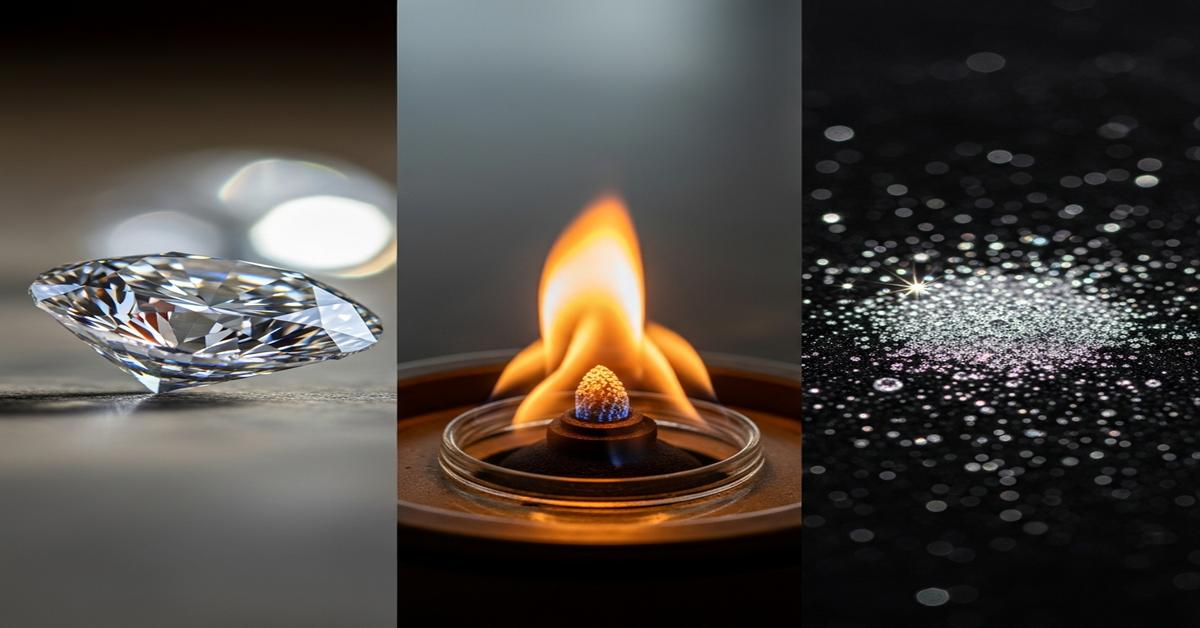
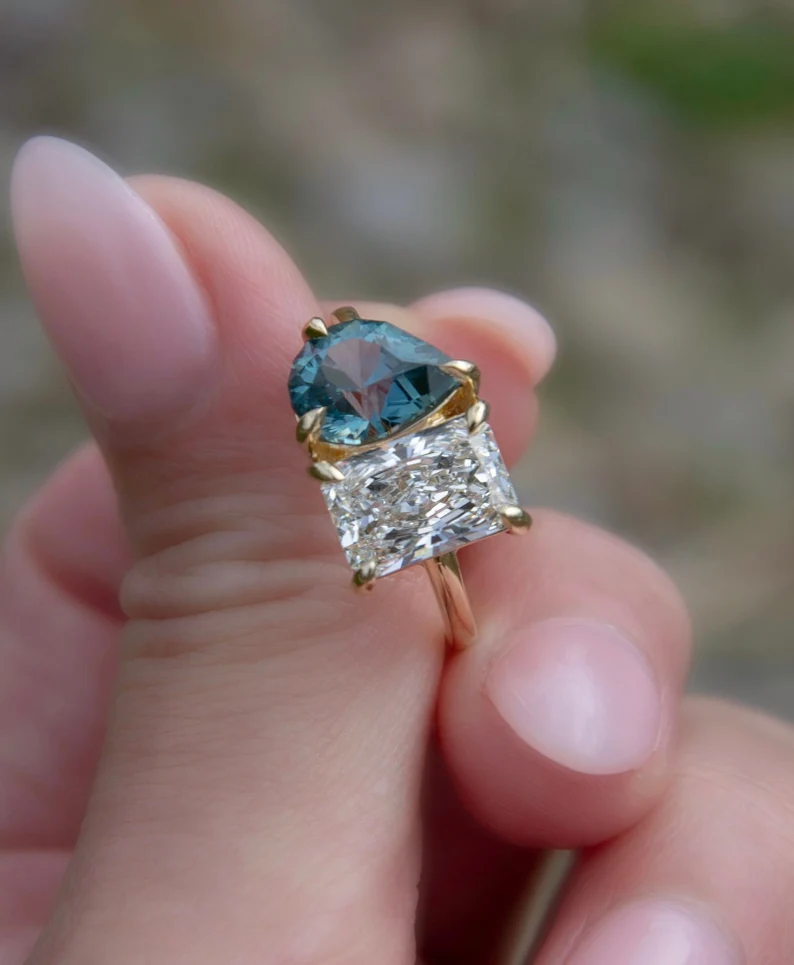
When you look at a finished gem and say it “sparkles,” you’re describing three related but distinct effects: brilliance, fire, and scintillation. Each comes from the way light interacts with the stone’s material and cut. Knowing the differences helps you choose a gem that looks the way you want — whether that’s white light return for classic sparkle, colorful flashes, or bold, moving contrasts.
What each term actually means
Brilliance is the return of white light to the eye. It depends on how much light entering the stone is reflected back out instead of leaking through the bottom. High brilliance looks like bright, continuous white areas when the gem is still.
Fire is the separation of white light into spectral colors — the little rainbows you see. Fire depends on the material’s dispersion (how differently it bends different wavelengths) and on facet geometry that encourages color separation.
Scintillation is the pattern of flashes you see when the stone, light, or observer moves. It describes both the frequency (many tiny sparks vs a few big flashes) and the contrast between bright and dark areas. Scintillation is what makes a ring look lively in motion.
The physics and why cut matters
Two optical properties matter first: refractive index (RI) and dispersion. RI controls how much light bends inside the material; higher RI gives stronger internal reflection and potential brilliance. Dispersion controls how strongly colors separate, which creates fire.
Examples: a diamond has RI ≈ 2.42 and dispersion ≈ 0.044 — good brilliance and modest fire. Moissanite has RI ≈ 2.65–2.69 and dispersion ≈ 0.104 — stronger fire and stronger brilliance. Sapphire has RI ≈ 1.76 and dispersion ≈ 0.018 — less fire and lower brilliance potential.
Cut ties the material to the final look. Key cut factors are:
- Pavilion angle: For round brilliants a common ideal is ~40.6–41.0°. Too shallow and light leaks (less brilliance); too deep and light exits the sides (smaller face-up area, duller look).
- Crown angle: Typical range ~34–36°. A steeper crown can increase fire because it disperses light more, but if too steep it reduces overall white return.
- Table size: Often 53–58% of the diameter for an ideal round. A larger table gives stronger white flashes; a smaller table increases contrast and can boost fire.
- Total depth percentage: Common ideal range ~59–62.5% for round brilliants. Depth affects face-up size and balance between leakage and reflection.
- Polish and symmetry: Fine polish reduces surface scattering; accurate symmetry aligns facets so light paths are consistent. Poor polish or off-center tables create light leakage and uneven scintillation.
Facet design and scintillation: why patterns differ
Scintillation is a product of facet size, shape, and contrast. Large facets produce broad “flashes” of light as the stone moves. Small facets produce many tiny sparkles. Contrast — alternating dark and bright areas — is what makes scintillation noticeable.
Round brilliants (57 or 58 facets) are cut to maximize balanced brilliance, fire, and scintillation. Step cuts (emerald, asscher) use long, narrow facets and yield broad flashes and low scintillation — a more architectural look. Fancy shapes (oval, marquise, pear) introduce effects like the bow-tie — a dark area across the center — which reduces perceived brilliance unless the cut is well proportioned.
Practical gemstone comparisons with numbers
- Diamond — RI ≈ 2.42, dispersion ≈ 0.044. With an ideal round cut (pavilion ≈ 40.7°, crown ≈ 34.5°, table ≈ 54–57%), you get strong white return and controlled fire. Diamonds reward precise cutting; small angle deviations noticeably change performance.
- Moissanite — RI ≈ 2.65–2.69, dispersion ≈ 0.104. It shows noticeably more fire than diamond. If you like colorful flashes, moissanite will appear “brighter” and more fiery, but many find its fire less subtle.
- Sapphire — RI ≈ 1.76–1.77, dispersion ≈ 0.018. Low dispersion means little fire; brilliance depends largely on cut and polish. Step cuts and mixed cuts are common to emphasize color and luster rather than fire.
- Cubic zirconia (CZ) — RI ≈ 2.15–2.18, dispersion ≈ 0.060. CZ can look very sparkly but has lower hardness and different wear characteristics; its fire can appear glassier than diamond.
Settings, size, and other perception factors
How a gem is set changes how much light can enter. A prong setting lets light reach the pavilion from many angles — that helps brilliance. A bezel hides the girdle and blocks side light, which reduces brilliance and scintillation.
Carat and millimeter matter for presence but not proportion. A well-cut 1.00 ct round is roughly 6.4–6.5 mm in diameter; a 0.50 ct is ~5.2 mm, and a 2.00 ct ~8.1–8.2 mm. Larger stones show more obvious scintillation patterns simply because facets are larger, but a poor cut on a large stone still looks dull.
Color and clarity affect perception. A noticeable body color in a diamond (e.g., faint yellow) can reduce the apparent white brilliance. Internal inclusions can scatter light and diminish sparkle. Fluorescence can make a diamond look whiter under UV-rich light, which can increase perceived brilliance in some lighting.
Quick buying checklist
- Check the report for cut grade and proportions (pavilion/crown angles, table and depth %). Those numbers tell you how the stone will handle light.
- Look for excellent/good polish and symmetry to avoid light leakage and odd scintillation.
- View photos or videos in multiple lighting conditions, and compare stones side-by-side if possible.
- Decide taste: do you prefer more controlled white brilliance (classic diamond look) or stronger rainbow fire (moissanite-like)? Let your eye choose.
- Consider setting style and metal color — both influence perceived brilliance and color.
Understanding brilliance, fire, and scintillation lets you translate a gem’s specs into visible performance. A good cut balances all three for the look you want; the material’s RI and dispersion set the limits. When in doubt, compare stones under the same light and remember: precise proportions and fine polish usually matter more than carat weight alone.