Blog
Solitaires Are Back—But With This 2025 Twist US Brides Didn’t Expect


Solitaires are back on brides’ fingers, but the look has changed. The clean, single-stone silhouette that once spoke only of tradition now hides a 2025-era agenda: bigger, cleaner, and smarter stones set in modern, low-profile architectures—with lab-grown diamonds, mixed metals, and engineered details that prioritize wearability and traceability. Brides aren’t just choosing a single stone for its symbolism. They’re choosing a smarter technical package that fits real life.
Why solitaires returned — and why now
Solitaires fell out of fashion for a while as halos and vintage clusters dominated. The return is logical: a single, well-cut center stone reads timeless and scales with budget. Two practical shifts pushed the revival in 2024–2025.
- Affordability of lab-grown diamonds. Lab-grown stones now cost significantly less than natural diamonds, so brides can buy a larger, higher-quality center stone without adding side stones to increase visual impact.
- Minimalism meets durability. Couples want jewelry that works with active lives. Simple solitaire heads are easier to protect, re-tip, and reset than elaborate halos that trap dirt and snag clothing.
The 2025 twist: lab-grown centers paired with engineered settings
The real surprise isn’t that solitaires are back. It’s that the modern solitaire is a technical object: lab-grown center stones paired with settings built for daily wear and sustainability.
Lab-grown diamonds as the default center. Lab-grown stones are common choices for 1.0–3.0 ct solitaires because price per carat falls dramatically compared with natural diamonds. For example, a 1.0 ct round brilliant is about 6.5 mm across; a 2.0 ct round is roughly 8.2 mm. That extra millimeter or two makes a dramatic visual difference without adding halo stones.
Engineered settings that protect and streamline. Brides favor bezel and low-profile four-prong settings, tension mounts, and hybrid heads (thin prongs plus a subtle bezel rim). Those choices reduce snags and protect girdles and culets—important for larger stones. Bezel walls are typically 0.8–1.0 mm thick; safe prongs start around 0.9–1.2 mm, not paper-thin decorative spikes.
Design details that matter — and why
- Mixed metals for visual balance. Using platinum (usually 950 alloy) for the head and recycled 14k gold (585 alloy) for the shank is now common. Platinum holds prongs longer and resists wear; 14k gold keeps the ring lighter and warmer in color. The result: a solitaire that reads pure from the finger but has performance-oriented construction beneath.
- Low-profile galleries and tapered shoulders. A head set 2.5–3.0 mm above the finger gives a slim silhouette while allowing airflow and easier cleaning. Tapered shoulders (2.0–1.5 mm at the shank to 0.9–1.2 mm near the head) emphasize the stone without bulk.
- Hidden personalization. Modern solitaires often carry a secret: a small pavé under the bezel, a colored melee on the underside of the head, or a tiny birthstone set into the gallery. From the top the ring is a classic single stone; up close it’s customized and intimate.
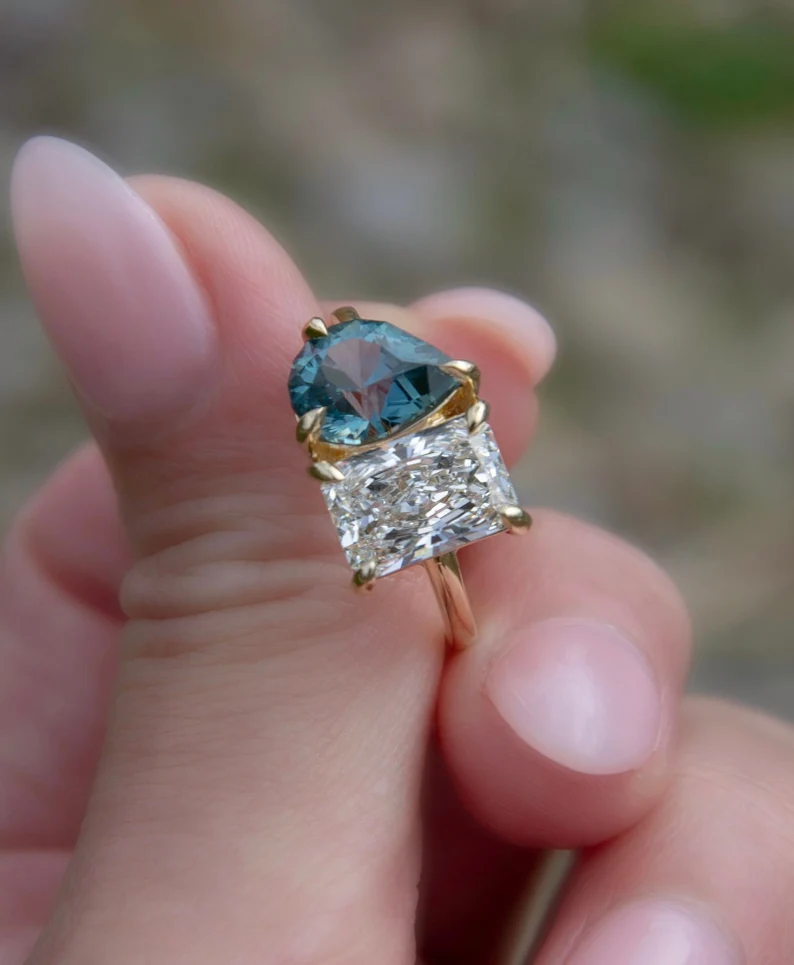
- Nontraditional cuts that maximize size Perception. Elongated ovals, radiants, and well-proportioned cushions can appear larger than round brilliants of equal carat weight. An oval 1.2 ct (approx. 8×5 mm) reads larger on the hand than a 1.2 ct round.
How to shop in 2025 — exact questions to ask
Don’t buy a solitaire on looks alone. Ask precise, technical questions so the ring works for daily wear.
- Is the diamond natural or lab-grown, and which lab certified it? GIA and AGS are gold standards for natural stones; IGI commonly certifies lab-grown stones. Certification tells you exact measurements, depth %, table %, and light performance data you need to compare stones.
- What is the alloy composition of the head and shank? Request numbers: platinum 950, 14k recycled yellow gold (585), 18k rose gold (750), or palladium 950. Each alloy behaves differently—18k is softer and dents easier than 14k.
- How thick are the prongs or bezel walls? Good daily-wear prongs are roughly 0.9–1.2 mm thick. Bezel walls that are too thin (under 0.7 mm) risk chipping the girdle when bumped.
- What is the cut grade and depth percentage? For rounds, target an Excellent/Very Good cut grade and a depth in the accepted range (usually 59–62% for ideal proportions).
- What warranty and maintenance are included? Solitaires will need occasional re-tipping and polishing. A routine maintenance plan is valuable for a daily wear ring.
Practical examples — what brides are actually buying
Here are three common 2025 profiles you’ll see in bridal shops:
- Everyday Classic: 1.0 ct lab-grown round brilliant (~6.5 mm), 4-prong platinum 950 head with a 14k recycled yellow gold shank. Low-profile gallery, minimal engraving. Chosen for durability and visible size without halo additions.
- Statement-but-simple: 2.0 ct lab-grown oval (approx. 10×7 mm), tension mount in platinum. The elongated shape reads large; the tension setting shows stone sides while securing it without snagging prongs.
- Heirloom-forward: 1.5 ct natural cushion with hidden pavé under the bezel, head in platinum and 18k rose gold shank. A natural center with modern hidden details keeps the vintage vibe but adds performance upgrades.
Bottom line
Solitaires in 2025 are not a return to the old default. They’re a refined, pragmatic choice: bigger-looking stones made affordable by lab-grown options, set in mixed-metal, low-profile constructions built for everyday life. Brides get the visual purity of a single stone with modern engineering, traceability, and personalization underneath. If you want a ring that reads timeless but wears like a piece meant for living, the new solitaire is exactly that—simple on the surface, smart where it counts.