Blog
Oval vs Radiant: Which Looks Larger on Small Hands? (Photo Comparisons)


When choosing a center stone for small hands, the shape matters as much as carat weight. Oval and radiant cuts both look modern and brilliant on the finger, but they read very differently in photos and in person. Below I compare how each shape *actually* appears on small hands, explain the optical reasons, and give concrete sizing and setting tips you can use when shopping or evaluating photos.
Quick visual difference: oval vs radiant
Oval: An oval is an elongated brilliant cut with a length-to-width (L/W) ratio typically between 1.25 and 1.5. That elongation spreads the diamond’s surface area along the finger. An oval of the same carat weight will often measure longer in millimeters than a square or round stone.
Radiant: A radiant combines trimmed corners with a brilliant-style facet pattern. Its L/W ratio is usually close to 1.0–1.2, so it reads squarer or slightly rectangular. Radiants often show strong scintillation but don’t extend along the finger the way an oval does.
Why an oval often looks larger on small hands
Perceived size is about surface area and how the eye measures length on a finger. Two key reasons ovals tend to appear larger in photos and on the hand:
- Length advantage: An oval’s longer millimeter dimension creates a bigger top view. For example, a 1.0 ct oval commonly measures around 7.5 x 5.5 mm, while a 1.0 ct square-ish radiant might be about 6.3 x 6.3 mm. Even though they weigh the same, the oval’s longer profile fills more finger space.
- Finger elongation: The oval draws the eye along the finger. On short, narrow hands this makes the finger appear longer and the stone more prominent in images.
Why a radiant can still look substantial
Radiants have strengths that help them hold visual weight:
- Brilliant faceting: Radiants often have tight scintillation and contrast, which reads as brightness and “pop” in photos. That sparkle can make the stone look impressive even if it’s not as long.
- Square footprint: On very narrow hands, a squarer face can balance proportions. It won’t elongate, but it can sit more centrally and appear bold rather than delicate.
Photo comparison examples (descriptive)
When you see photos, compare these test cases to judge size visually:
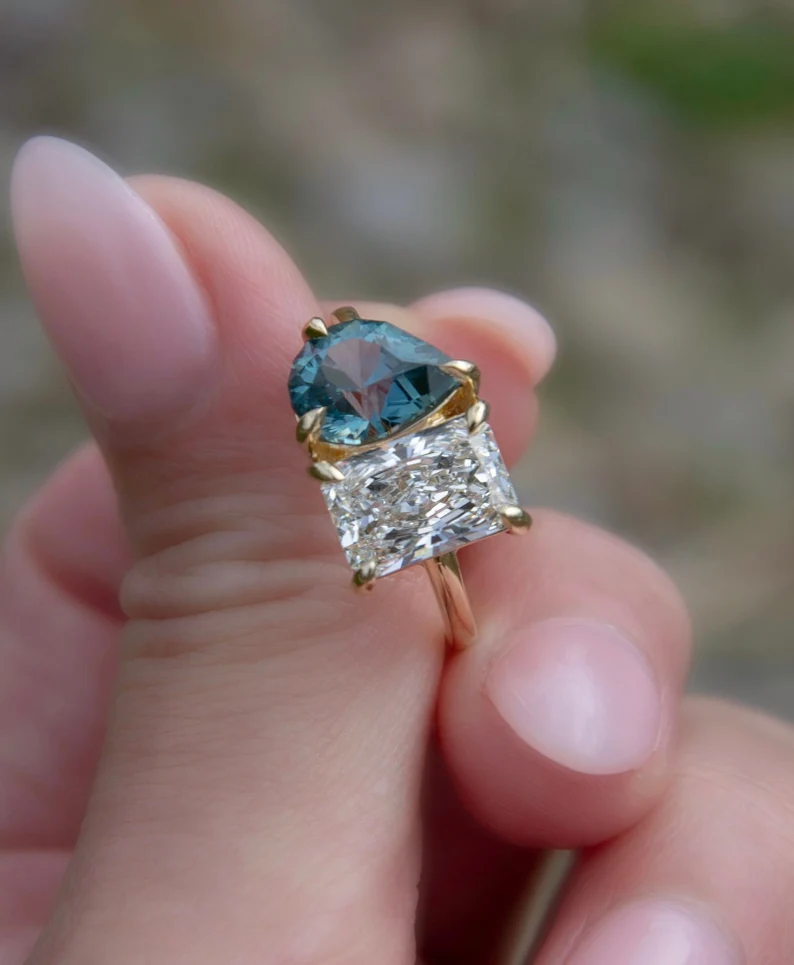
- Example A — 1.0 ct Oval, ~7.7 x 5.5 mm, L/W 1.4: On a ring size 5 (finger width ~15 mm) the oval fills more vertical space. In photos it appears noticeably larger than a square 1 ct because the longer axis contrasts with the finger’s short width.
- Example B — 1.0 ct Radiant, ~6.3 x 6.3 mm, L/W 1.0: On the same finger the radiant looks squat but very sparkly. From a distance it can read as a slightly smaller surface area than the oval, though it may look thicker and more solid.
- Example C — 0.9 ct Oval with halo vs 1.0 ct Radiant solitaire: A thin halo around the 0.9 ct oval (6.8 x 5.0 mm) often wins for apparent size. Halo plus thin band increases the visual diameter more than the extra 0.1 ct in a radiant solitaire.
Settings and metal choices that affect perceived size
Settings change how big a stone looks in photos. Here’s what matters:
- Halo vs solitaire: A halo adds about 1–2 mm to the visual diameter, making smaller stones read much larger. For small hands, a halo around an oval can create the largest-looking ring without adding carat weight.
- Bezel vs prongs: Bezel settings wrap metal around the edge and reduce apparent size. Four or six prongs with minimal metal let the stone read larger.
- Band thickness and metal: Thin bands (1.5–2 mm) make the center feel bigger. Use 14k gold (about 58.3% gold alloy) if you want strength and can keep the shank slim. Platinum bands tend to be thicker (for durability) and will slightly reduce the apparent size of the center stone.
- East-west ovals: Turning an oval sideways can emphasize width rather than length. That can be useful if you want a bold look without elongation, but it won’t make the stone look larger top-down.
Cut proportions and optical size
Don’t shop by carat alone. Millimeters and depth % tell the truth about top-facing size.
- Table and depth: A shallow-cut stone spreads carat weight into a larger table. For brilliant cuts, typical depth ranges are ~56–64%. Ovals with shallower depths and wider tables will look bigger. Radiants sometimes run slightly deeper; that puts more weight under the table and makes them look smaller top view for the same carat weight.
- Ask for mm measurements: Request exact length x width x depth in millimeters and the table/depth percentages. Compare top-surface area (length × width) rather than carat alone.
Practical buying tips for small hands
- If you want maximum apparent size: Choose an oval with an L/W between 1.25–1.45 and prioritize millimeters. Add a thin halo or thin prong setting. Example: a 0.9–1.1 ct oval around 7.0–8.0 x 5.0–6.0 mm will read large on a size 4–6 finger.
- If you prefer a bold, compact look: Go radiant. Choose a slightly larger carat or halo if you need more top-face area. Example: a 1.0–1.2 ct radiant around 6.3–7.0 mm square with a halo balances small hands well.
- Try real-world comparisons: Photos can be misleading. Try on stones with similar mm measurements in different shapes. If you’re viewing photos, ensure the finger size in the image is similar to yours or ask for a scale object in the shot.
- Consider metal and band: Use a thin band in 14k gold or platinum if you want durability. Avoid heavy shanks that make the gem look smaller.
Final takeaway
For small hands, an oval usually appears larger than a radiant at the same carat weight because of its elongated millimeter profile and finger-elongating effect. But radiants offer strong brilliance and a compact, bold look. The best approach is to compare exact mm measurements, check depth/table percentages, and consider setting choices (halo, band thickness, prongs). When possible, view or request photos that include a finger size reference so you can judge how the stone will read in real life.