Blog
Coordinates, Dates, or Initials? The Engraving You Won’t Regret in 10 Years

Coordinates, Dates, or Initials? The Engraving You Won’t Regret in 10 Years
Engraving turns a piece of jewelry into a record of a moment. But what you choose, where it sits, and how it’s engraved determine whether that record will still be clear a decade from now. Below I explain the practical differences between common engraving types — coordinates, dates, initials, and others — and give concrete, technical guidance so your inscription still reads as intended after years of wear.
How engraving ages — the basics
Engraving longevity depends on three things: depth, placement, and metal. Deeper cuts stay legible longer because normal polishing and surface wear take time to remove material. *Machine (rotary) engraving* typically cuts about 0.2–0.5 mm deep. *Laser engraving* is usually shallower, often 0.05–0.2 mm, but it can be very precise for fine detail. *Hand engraving* can be deeper and more durable, around 0.3–0.6 mm, but it’s more costly and depends on the engraver’s skill.
Placement matters. Inside a wedding band is protected from knocks and abrasion; outside or on a flat pendant face gets more contact and will fade faster. Metal hardness matters too. Metals that hold detail well include:
- Platinum (typically 95% Pt) — very dense and durable; holds crisp engraving for many years.
- 14k gold (≈58% Au) — harder than 18k; details wear more slowly. Good balance of durability and color options.
- 18k gold (≈75% Au) — softer and will show wear faster; still fine for inner-band engraving if depth is adequate.
- Sterling silver (92.5% Ag) — soft and prone to surface wear and polishing; engravings soften sooner.
Which message lasts best and why
Short, compact, and unambiguous inscriptions age best. That rules in some options and out of others.
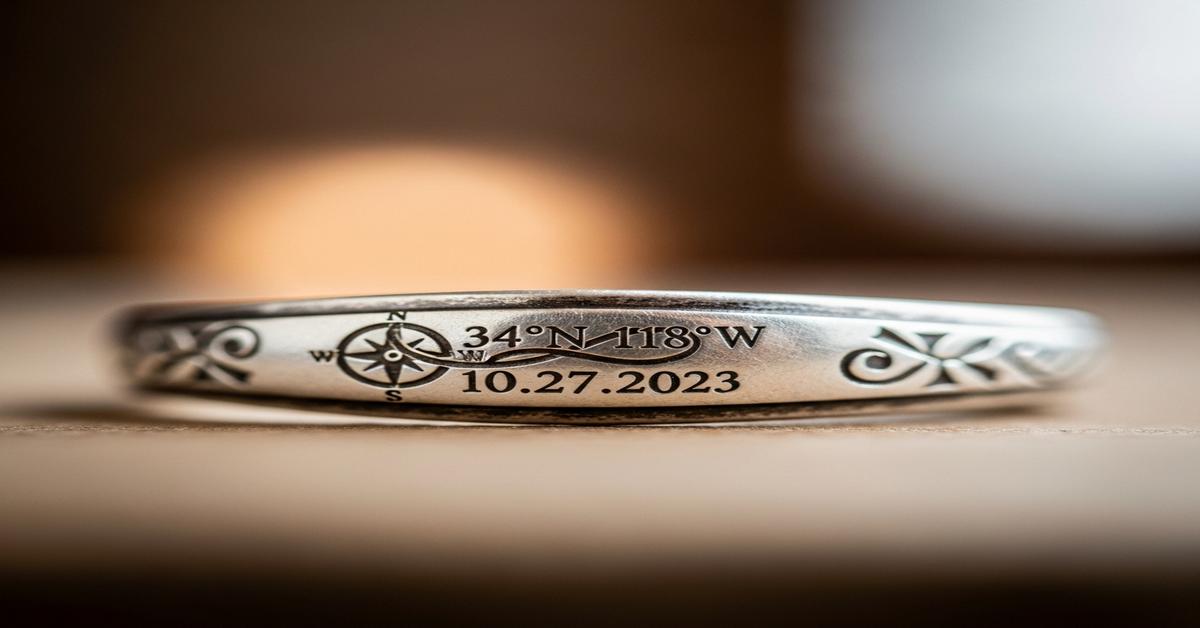
- Coordinates — A great long-term choice. They’re compact, timeless, and uniquely tied to a place rather than a trendy phrase. Use decimal format with four decimal places for a clear, modern look and manageable length. Example: 40.7128 N, 74.0060 W. Four decimals gives ~11 m precision; more digits add length without much everyday benefit.
- Dates — Keep them unambiguous. Use the full four-digit year or spell the month. For example, 09 Nov 2025 or 2025-11-09. Avoid two-digit years like “’25,” which can be misread later. Dates are short and meaningful; they wear well when characters are simple and deep enough.
- Initials or Monograms — Very durable because they’re brief. Choose block capitals instead of script. Example: A.B. or a three-letter monogram with the family name initial centered. Monograms work well on rings and signet-style pieces.
- Short Quotes or Sayings — Riskier. They take space, use smaller characters, and are more likely to become illegible after polishing. Also personal tastes change; what’s meaningful now might feel heavy later.
- Biometrics (fingerprints, handwriting) — Unique and emotionally resonant, but detail can blur over time unless engraved deeply. Expect higher cost and more careful placement to preserve detail.
Formatting rules that avoid regret
Small decisions determine legibility later. Follow these concrete rules:
- Font: Pick a simple sans-serif or a clean serif. Avoid script or cursive for small inscriptions; loops and thin strokes disappear with wear.
- Case: Use uppercase for initials and short texts. Uppercase letters are more legible at small sizes.
- Size: For inner rings, aim for character height of at least 1.5 mm. Smaller than 1.2 mm becomes hard to read and fades faster.
- Depth: Ask for 0.2–0.5 mm for machine engraving. If you choose laser, request the deepest laser setting the jeweler recommends. For hand engraving, 0.3–0.6 mm gives best longevity.
- Spacing: Keep total character count modest. A typical 4 mm wide band comfortably fits 10–12 characters inside without squeezing letters too small.
- Rhodium-plated white gold: Clarify whether engraving happens before or after plating. Rhodium plating is very thin (microns); repeated replating and polishing can soften shallow engraving. Prefer engraving after final plating or ask for deeper cuts if engraving first.
Examples and when to choose each
Here are practical pairings of message, metal, and placement with reasons:
- Coordinates on an inner platinum band: Example: 40.7128 N, 74.0060 W. Platinum holds detail and the inner surface protects the text. Ideal if you want a quiet, nearly permanent marker.
- Full date on a 14k gold ring: Example: 09 Nov 2025. Use block letters and 0.3 mm depth. 14k balances hardness and color, which helps the engraving stay sharp.
- Initials on a signet or pendant face: Example: J.T. Engrave on the outside if you want it seen; choose deeper hand engraving for a classic look that resists polishing.
- Short quote on a cuff bracelet: Keep it to 2–3 words and choose high-contrast placement (matte background, polished letters) to aid legibility over time.
Practical checklist before you commit
- Get a mock-up. Ask the jeweler for a scale image showing font, size, and spacing.
- Confirm engraving depth and method. Ask for numbers (mm) not just “deep” or “standard.”
- Think about resizing. Rings that will be resized can distort or remove inside engraving. If you expect resizing, choose a deeper engrave and keep the text short.
- Ask about plating order. For plated pieces, engraving after plating or deeper cutting before plating preserves detail.
- Check the warranty or re-engraving policy. Many jewelers will re-engrave or touch up for a fee if the inscription fades within a certain period.
Bottom line: choose a concise, unambiguous message (coordinates, full-year dates, or initials), pair it with a durable metal (platinum or 14k gold), use simple type, and insist on sufficient depth. That combination maximizes the chance your engraving still reads clearly—and still means something—ten years from now.