Blog
Inside-Shank Secrets: The Tiny Symbols Couples Hide

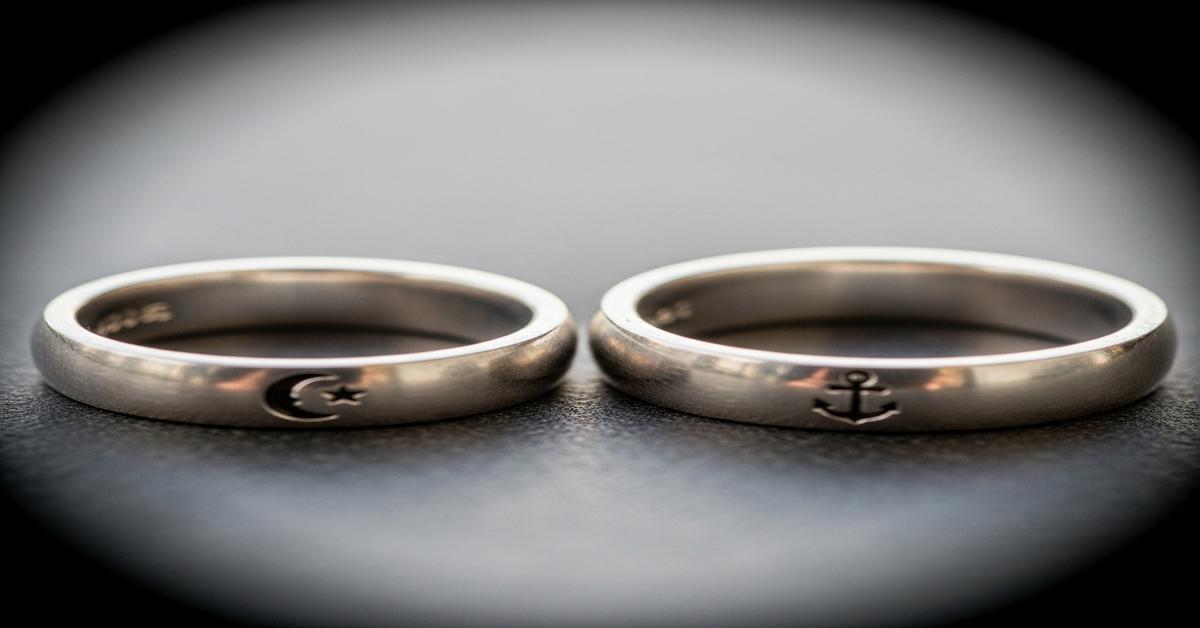
Couples have long used the inside of a ring as a private place to keep messages. These marks can be names, dates, tiny symbols, even a soundwave of a voice. Inside-shank engravings are small but meaningful. They require choices about method, metal, font size and future care. This article explains the practical trade-offs so you can plan a secret that lasts.
Why couples hide messages inside the shank
Inside-shank engravings keep personal information private. They don’t show during day-to-day wear. Couples use the space for things they want to feel close to — a wedding date, coordinates of a first kiss, a private nickname or a tiny icon only the two of them know. Hidden marks also avoid changing the external design of the ring. That keeps the ring’s look intact while adding meaning.
Common secret languages and symbols
- Dates and initials — The most common. Short and timeless (e.g., 6/14/20 or A ◊ M).
- Morse code — Dots and dashes made with groove and flush-set stones. Subtle and private.
- Coordinates — Decimal degrees like 40.7128° N, −74.0060° W for a special place.
- Soundwave or waveform — A laser can engrave the waveform of “I love you” or a meaningful phrase. It’s a modern fingerprint.
- Fingerprint or tiny photo — Micro-laser engraving can reproduce a fingerprint or small portrait inside the shank.
- Hidden gemstones — A flush-set 1.0 mm diamond (about 0.005 ct) or a colored stone as a birthstone marker.
How engravings are made — techniques and what they mean
There are three common methods, each with strengths.
- Hand engraving — Done by an engraver with tools. It creates depth and character. Depths are typically 0.10–0.25 mm. Hand engraving is durable because of the carved profile, and it wears gracefully with polish.
- Machine (pantograph/CNC) — A milling tool that traces a pattern. Consistent and good for repeated fonts. Depths usually match hand work, about 0.10–0.25 mm, depending on the tool.
- Laser micro-engraving — Uses a focused beam to ablate metal. It can reproduce photos and soundwaves and can engrave extremely fine lines down to under 0.1 mm. Laser marks can be very crisp but are often shallower. If done too shallow, polishing and daily wear will fade the mark faster.
Material matters: alloys and how they hold marks
- Platinum (Pt950) — Very durable and dense. Engravings hold well and resist wear. Good for deeper carving.
- 18k gold (75% Au) — Softer than 14k. It carves nicely but will polish away shallower marks faster. Consider slightly deeper engraving if you choose 18k.
- 14k gold (58.3% Au) — Harder than 18k because of more alloy content. It resists wear better and is a practical choice for long-term legibility.
- White gold — Usually rhodium plated. If the ring is plated, engrave after plating or be prepared to replate; plating can fill and mask shallow marks.
Design constraints: size, depth and placement
Engraving success depends on ring width, interior shape and intended message length.
- Shank width — Under 2.5 mm: limit to single characters or tiny symbols. 2.5–4 mm: you can fit short words or dates. 4 mm and wider: you can fit longer phrases or complex waveforms.
- Interior profile — Comfort-fit rings have a rounded interior. That curvature reduces usable depth and can distort fine text. Flat interiors are better for detailed engraving and photos.
- Font height and depth — For clear legibility, choose letters at least 1.0–1.2 mm tall when possible. Depths of 0.10–0.25 mm are common. If you want the engraving to remain visible through polishing and years of wear, plan for deeper work (0.25–0.40 mm), but only if the ring wall thickness supports it.
- Spacing from seam — If a ring may be resized, place engravings away from the sizing seam. Resizing up or down can stretch, compress or remove part of the inscription.
Hidden gemstones and flush settings
Small stones inside the shank are a popular secret. A 1.0 mm diamond is roughly 0.005 ct and makes a subtle sparkle. A 1.5 mm stone is about 0.011–0.015 ct and is still discreet. Flush setting is safest; the stone sits level with the metal so it doesn’t snag. Choose platinum or 14k for better long-term stone security. Discuss prong vs flush options with your jeweler; prongs inside the shank are uncommon because they can catch and cause discomfort.
Longevity, resizing and care
Plan for the future. Resizing is the most common risk to inside-shank secrets.
- If you expect to resize, avoid placing an inscription right where the jeweler will cut and solder the shank. Ask the jeweler to mark a safe zone.
- Shallow laser marks can be polished away. If you want permanence, request a deeper hand or machine engraving when possible.
- Replating (white gold) can mask or fill very shallow marks. Re-engrave after plating or ask for engraving that penetrates the plating thickness.
- Document the inscription with a photograph or certificate. If a ring is lost or serviced years later, you’ll have a record of the original secret.
How to commission an inside-shank secret
Follow these practical steps to get what you want.
- Decide the message — Keep it short. Test the idea on paper at actual scale if possible.
- Choose the metal and ring width — Prefer platinum or 14k for durability if longevity matters.
- Ask for a mockup — A sketch or laser preview shows scale and placement. Request the exact font and letter height in mm.
- Discuss method and depth — For text, hand or machine engraving at 0.10–0.25 mm is standard. For photos or waveforms, request laser but ask for a slightly deeper mark so it survives polishing.
- Plan for resizing — Tell the jeweler if you may need size changes later. Place the engraving away from seams or choose a method that can be re-cut.
- Get documentation — Photograph the finished engraving and note method, depth, and exact wording or symbol.
Inside-shank engravings are small promises. The right choices in metal, method, depth and placement make those promises last. Talk with an experienced jeweler, get a scaled mockup, and document the work. That way your private message stays private — and readable — for years.