Blog
Lighter Test on Moissanite: Please Don’t—Here’s Why

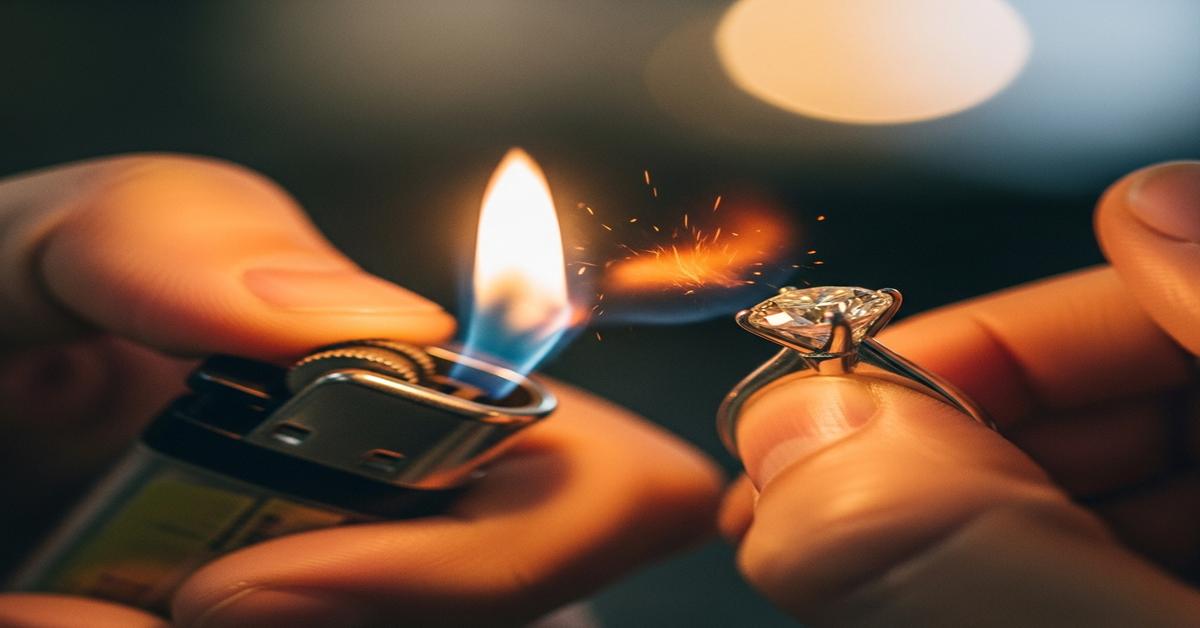
Using a lighter to “test” moissanite looks simple on social media: hold a flame to the stone, and if it’s real, nothing bad happens. Please don’t. Flame tests don’t prove anything about authenticity, and they can quietly damage your gem and your setting. Here’s the science, what really happens under heat, and safer, reliable ways to tell moissanite from diamond.
Where the lighter test myth comes from
Two ideas fuel this myth. First, people assume only diamonds survive heat. Second, they think heat will make “fakes” crack or change color. Reality is more nuanced:
- Moissanite (silicon carbide) is extremely heat-resistant. It was literally discovered in a meteor crater and remains stable at temperatures far beyond a pocket lighter.
- Diamonds and moissanites both tolerate brief flame better than most simulants, so a pass/fail flame test doesn’t separate them.
- Thermal shock, not just heat, causes damage. Rapid heating or cooling, especially in a mounting, can create fractures or loosen stones regardless of authenticity.
What actually happens when you flame moissanite
Moissanite’s crystal is robust, but the way you heat it matters.
- Heat tolerance is high. Moissanite remains stable at temperatures over 1,000°C. A lighter’s inner blue cone can approach that range. Stability doesn’t equal safety, though.
- Thermal shock risk is real. The coefficient of thermal expansion for silicon carbide is higher than diamond’s. Heat one side of a stone fast (especially if it’s in a 4-prong head), and you create uneven stress. Quench it or blow on it, and micro-fractures can form along stress lines. You won’t always see them immediately.
- Soot and surface haze. Lighters burn incompletely and leave carbon soot on facets. Rubbing can create fine polish abrasions that dull brilliance.
- Mounted stones are more vulnerable. Metal prongs heat and cool at different rates than the stone. Expansion and softening can loosen claws or shift seat pressure, inviting future chips at the girdle.
- No reliable color change. Quality colorless moissanite (D–F) won’t turn yellow or cloudy in a lighter flame. If you see a film, it’s usually residue, not a genuine identity clue.
Why it won’t prove anything
Even if nothing “bad” happens, you’ve learned very little:
- Diamond vs moissanite. Both typically survive a brief flame without visible change. Heat does not distinguish them.
- CZ and glass aren’t predictable. Cubic zirconia sometimes survives light flame; glass may craze or crack—but not always. Inconsistent outcomes make the test meaningless.
- You can mask damage. Soot can hide surface issues until you clean. Micro-cracks may only be visible under 10x loupe or later when a prong is tightened.
Collateral damage you’ll cause
The bigger risk is to everything around the stone.
- Prongs and solder joints. Common solders on 14k–18k gold flow roughly between 600–750°C. A lighter’s hot zone can exceed this, risking joints and softening prongs. Platinum resists better but still transfers heat into neighboring components.
- Rhodium plating on white gold. Thin rhodium (≈0.10–0.25 microns) can burn or discolor, leaving yellow-gray patches that require re-polishing and re-plating.
- Finish and engravings. Soot embeds in fine milgrain and hand-engraved recesses, dulling detail.
- Adjacent gems. Melee diamonds may be fine, but heat-sensitive stones (opal, emerald, garnet, tanzanite) in the same ring or nearby bands can crack or lose oiling. Any accents set with adhesive (rare but happens in fashion jewelry) can pop out.
Safe ways to tell moissanite from diamond at home
Nothing at home is foolproof, but these methods are safer and more informative than a lighter:
- Look for double refraction under 10x. Moissanite is doubly refractive. Through the crown, rotate the stone and look for doubled facet junctions. Check from several angles; looking straight down the optic axis can hide doubling.
- Evaluate the “fire.” Moissanite’s dispersion (~0.104) is over double diamond’s (~0.044). In mixed lighting, moissanite throws bolder rainbow flashes. Not definitive, but suggestive on stones 6.5 mm and larger.
- Measure size vs weight. Density: diamond ≈3.52 g/cm³, moissanite ≈3.22 g/cm³. A round 6.5 mm diamond is about 1.00 ct; a 6.5 mm moissanite often weighs ~0.88–0.92 ct. If you can measure diameter and carat weight, a consistent ~8–10% shortfall hints at moissanite. Note: moissanite is typically sold by millimeter, not carat.
- Facet edges and girdle. Under magnification, moissanite sometimes shows slightly softer girdle abrasion over time compared to diamond’s crisp edges. This is subtle and depends on wear and polish quality.
- Fog test is weak. Both diamond and moissanite clear condensation quickly thanks to high thermal conductivity. Don’t rely on it.
The tools a jeweler uses (and what they read)
Pros combine multiple instruments because no single test is perfect.
- Thermal conductivity tester. Moissanite often “reads as diamond” due to high thermal conductivity, which is why many “diamond testers” misidentify it. This is expected.
- Electrical conductivity tester or multi-tester. Moissanite is typically electrically conductive (n-type); most diamonds are not (exception: rare blue boron-bearing Type IIb). A positive conductivity reading after a diamond-like thermal reading strongly indicates moissanite.
- Magnification and optics. A gem microscope or a 10x loupe reveals doubling, specific inclusion patterns, and facet junction behavior. A polariscope can confirm double refraction. Reflectivity meters help when refractive index exceeds standard refractometer limits.
- Weight and measurement check. The jeweler compares millimeter size to carat weight to corroborate identity.
If you already tried a lighter: what to check
Don’t panic—moissanite likely survived, but inspect carefully.
- Clean first. Use warm water, mild dish soap, and a soft brush to remove soot. Avoid shock: no ice water after heat exposure.
- Loupe the stone. Check the girdle for new nicks, the crown for hazy patches, and the table for fine abrasions.
- Test prong tightness. Gently tap the shank near your ear; a rattle means a trip to the jeweler.
- Look at the metal. Any color shift on white gold likely means the rhodium is burned; re-plating restores it.
Practical identification examples
- Example 1: 6.5 mm round in 14k white gold solitaire. Thermal tester says “diamond.” Electrical conductivity is positive. 10x reveals faint doubling on pavilion facets. Weight is 0.92 ct. Verdict: moissanite.
- Example 2: 7.0 mm round three-stone ring with melee. Strong rainbow flashes under mixed light, but thermal tester says “diamond.” Electrical test is negative. No doubling seen at multiple angles. Weight aligns with ~1.25 ct diamond. Verdict: diamond.
Bottom line
Flame won’t tell you if a stone is moissanite, and it can harm the setting or induce stress you won’t notice until later. Skip the lighter. Use a loupe for doubling, compare size to weight, and—best of all—have a jeweler run thermal and electrical tests. You’ll get a clear answer without risking your ring.