Blog
Hearts & Arrows or Marketing? What You Actually See Without a Loupe

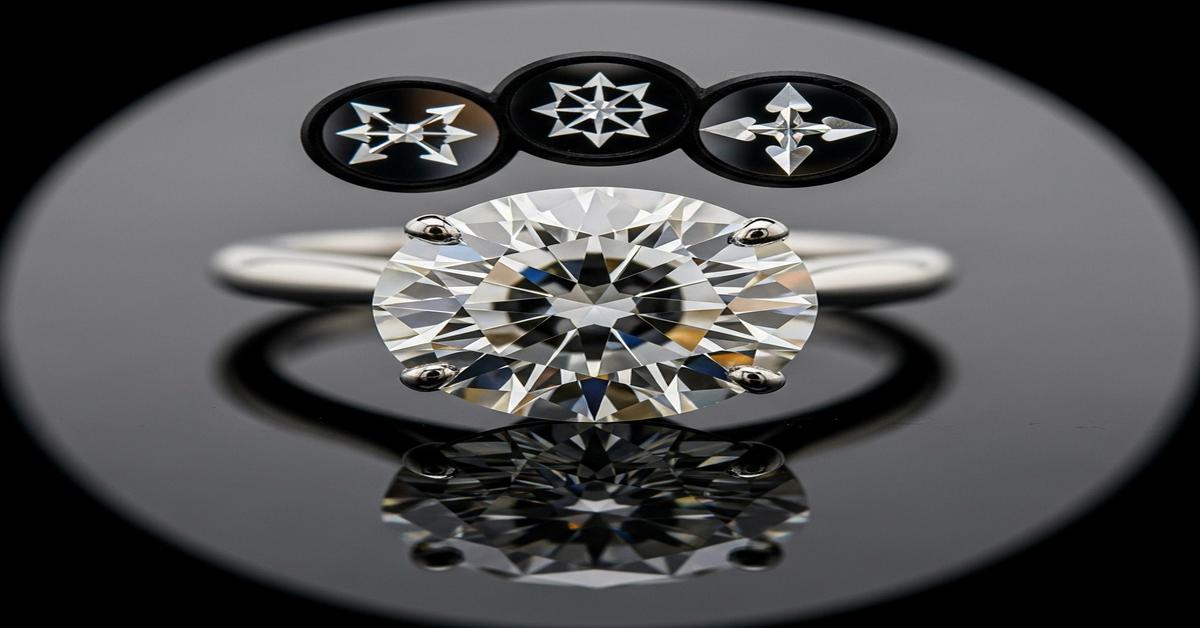
When you hear “Hearts & Arrows,” you’re hearing both a precise optical phenomenon and a marketing shorthand. The term describes a round brilliant cut with extreme facet symmetry that produces eight crisp arrows when viewed from the top (crown) and eight hearts when viewed from the bottom (pavilion) with a special viewer. But most buyers never use a loupe or an H&A viewer. This article explains what that pattern actually means for what you can see with the naked eye, why it matters (or doesn’t), and what to prioritize when buying a round brilliant diamond without magnification.
What Hearts & Arrows really is
Hearts & Arrows (H&A) diamonds are round brilliants cut to very tight symmetry tolerances. Typical target proportions for an H&A are a table around 53–58%, total depth around 58–62%, crown angle about 34–36°, and pavilion angle about 40.4–40.8°. Those numbers are close to “ideal” proportions and produce predictable light return patterns. The H&A pattern itself is only visible with a viewer that isolates crown or pavilion reflections and magnifies them. So H&A is an optical descriptor of facet alignment, not a guarantee of how the diamond will look at arm’s length.
What you can actually see without a loupe
- Overall brightness (face-up light return). A well-cut H&A will often look very bright face-up because light is returned to the viewer rather than lost through the sides. Brightness is the single most noticeable quality from a normal viewing distance. You don’t need a loupe to see it.
- Scintillation (sparkle when moving). Tight symmetry often creates more even, pleasing scintillation—small flashes across the surface as the diamond moves. You’ll notice this in videos or when you tilt the ring under a light source.
- Contrast pattern. You can usually see a pleasing pattern of light and dark areas that gives a diamond depth and character. H&A cuts tend to show crisp, evenly spaced contrast facets. They won’t display the clustered dark areas that indicate poor facet alignment.
- Fire (dispersion of color). Fire depends on proportions but also on lighting. Under warm incandescent light you’ll see colorful flashes; under cool daylight the diamond may look whiter. H&A doesn’t guarantee more fire, but well-balanced proportions often produce good fire without sacrificing brightness.
- Windowing and leakage. A poorly cut stone can look washed out or “see-through” in the center. An H&A-quality stone is less likely to have a large window or dark leakage because the facets are aligned to return light face-up.
What you won’t see without a loupe or special viewer
- The actual arrows or hearts pattern. Those patterns are only visible with a viewer that isolates the reflections of specific facets. You won’t see crisp arrows with the naked eye at normal viewing distances.
- Minute symmetry flaws. Small misalignment of a star facet or an out-of-center culet can be detected by loupe or scope but won’t change the diamond’s look at arm’s length unless the flaw is large.
- Facet junction quality. Tiny nicks, extra facets, or imperfect facet meetups are visible under magnification and affect grading, but they rarely change face-up performance noticeably.
Why H&A is part science, part marketing
H&A is scientific in that precise symmetry produces predictable light patterns under controlled viewing. But it’s also a marketing label that commands a premium. Some vendors label stones “H&A” based on ideal-scope or viewer images; others use the name more loosely. The key is that H&A indicates extreme symmetry—but extreme symmetry alone is not the only factor that determines how attractive a diamond looks without magnification.
What matters more for naked-eye appearance
- Face-up brightness and contrast. These are immediate to the eye. Favor stones that look lively and balanced in photographs and video under both daylight and warm indoor light.
- Proportions over labels. Use concrete numbers: table 53–58%, depth 58–62%, crown 34–36°, pavilion 40.4–40.8°. These ranges tend to yield strong face-up performance for round brilliants. If a diamond labeled H&A sits within these ranges, it’s more likely to look excellent at arm’s length.
- Grading report grades. Look for GIA or AGS reports. An AGS 0 or GIA Excellent symmetry/polish indicates very tight craftsmanship. Those grades correlate with better visual performance more reliably than a vendor’s H&A sticker alone.
- Lighting in images and video. Ask for face-up photos and a short video while tilting. The way the diamond handles movement shows scintillation and windowing much better than a claim about hearts and arrows.
Practical inspection checklist when you don’t have a loupe
- Examine face-up brightness under daylight and warm light. The diamond should look lively, not dull or washed out.
- Ask for proportions and grading report. If the stone is 1.00 ct (~6.5 mm), check that depth is near 60% and table near mid-50s.
- Request an ideal-scope or ASET image if you’re evaluating light performance. These reveal light return patterns even if you can’t see hearts and arrows unaided.
- Look for even scintillation in video. Sharp, consistent flashes across the stone are good. Large dark patches or a “see-through” center are not.
- Prefer AGS 0–1 or GIA Excellent symmetry/polish for the highest chance of true H&A-level facet alignment.
When H&A is worth paying extra for
If you value craftsmanship and want the assurance of extremely tight symmetry, H&A can be worth a modest premium—especially for larger stones (1.5 ct+) where misalignment is easier to spot. The premium is less important on smaller stones because fine symmetry differences are harder to see without magnification. If you mainly care how the ring looks on the finger, prioritize face-up brightness and balance over the H&A label.
Bottom line
Hearts & Arrows indicates high symmetry and often correlates with excellent face-up performance. But the actual H&A pattern is invisible without a loupe or viewer. For most buyers, the right priorities are concrete proportions, independent lab grades (GIA or AGS), and real-world photos or video showing brightness and scintillation. If you want the peace of mind of extreme symmetry, ask for ideal-scope or H&A viewer images and expect a small premium. If you want the best-looking diamond to the naked eye, use the checklist above and judge face-up performance first—labels should support that evidence, not replace it.