Blog
Why G-Color Looks Different in Dallas vs Seattle Lighting (Side-by-Side)

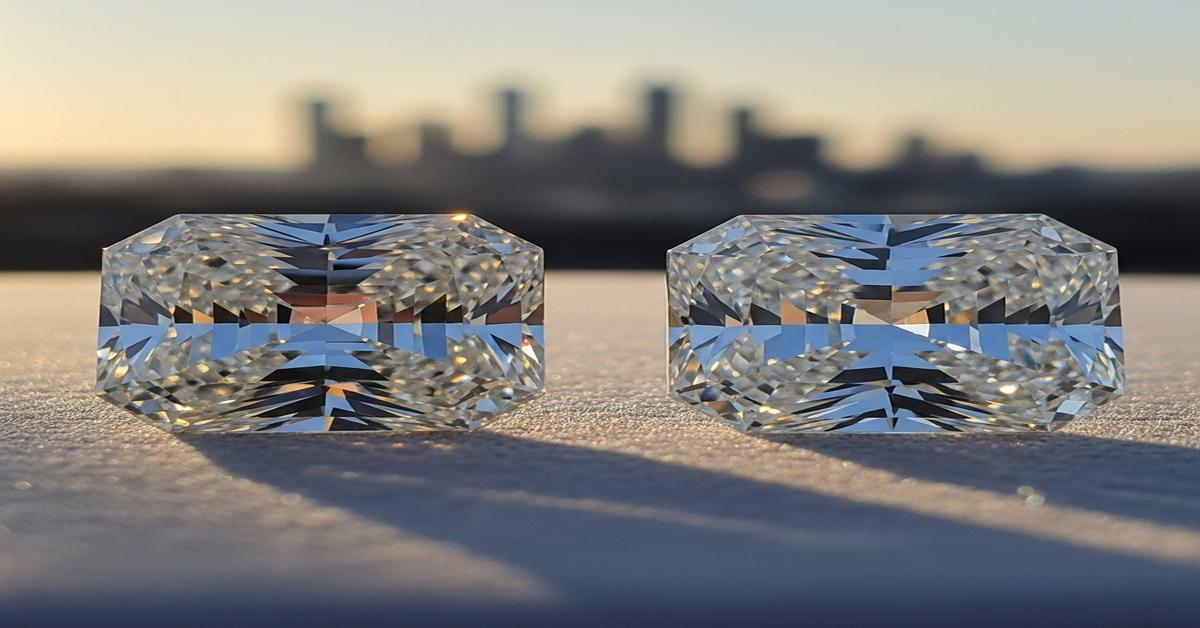
When a G-color diamond looks slightly different in Dallas than it does in Seattle, you are seeing a mix of physics, human perception, and jewelry choices at work. A G graded diamond is in the “near-colorless” range. That means it has only a small warm tint that becomes visible under some conditions. Lighting, the stone’s cut and size, the metal around it, and atmospheric factors all change how that tint reads to your eye. Below I explain the specific reasons and show practical side-by-side examples so you know what to look for when buying or comparing diamonds in different cities.
How light source changes color appearance
Light is not one uniform thing. Different sources have different amounts of red, green, and blue across the spectrum. Two measurements matter:
- Correlated Color Temperature (CCT) — measured in Kelvin (K). Incandescent bulbs are warm (~2700K), midday sun is neutral to cool (~5500–6500K), and an overcast sky can be bluer (~7000–8000K). Cool (higher K) light emphasizes the blue end of the spectrum and can make a diamond look whiter. Warm light emphasizes yellow/red and can reveal the stone’s faint warmth.
- Color Rendering Index (CRI) — how accurately the light source shows color. Sunlight has CRI ≈100. Cheap LEDs or fluorescents with low CRI can shift perceived color, making a G stone look off.
Example: a 1.00 ct G, round brilliant (6.5 mm) in Dallas under bright, sunny late-afternoon light (warm 5200–5800K with some ground-level dust) may show a touch of warmth. The same stone in Seattle on an overcast day (diffuse 7000K light) will often look cooler and therefore “whiter.”
Atmosphere and geography matter
Dallas and Seattle differ in humidity, cloud cover, and airborne particles. Those differences change the light’s spectral balance before it reaches the diamond.
- Dallas — frequent direct sun, lower relative humidity at many times of year, and more dust/haze. Direct sunlight yields strong directional light that increases contrast and can bring out warm tones in a G stone, especially late afternoon when sunlight shifts warmer (lower K).
- Seattle — more overcast and diffuse light. Clouds scatter sunlight and boost the blue component of ambient light. Diffuse light reduces harsh shadows and often reduces the visible warmth of near-colorless stones.
Cut, shape, and size change perceived color
Two diamonds with the same G grade can look different because of cut and size. Why? The way a stone returns light to the eye changes the balance between white light and colored body tone.
- Round brilliants hide color best. Their many facets return bright white light (brilliance), masking the faint yellow tint. A 0.75–1.25 ct round G (about 5.7–6.5 mm) will usually look very white in most lights.
- Step cuts (emerald, asscher) show color more. They have larger, flatter facets and less scintillation, so body color is more visible. A 1.50 ct emerald cut G (roughly 8.5 x 6.0 mm) will often look warmer in warm indoor lighting.
- Size — as carat and table size increase, the path of light through the stone grows, and more of the stone’s body color can be seen. Above ~1.25–1.50 ct, G color becomes easier to spot under warm light.
Metal and mounting affect the face-up look
The ring metal changes color contrast. Yellow gold reflects warm tones into the pavilion; platinum or white gold reflects cooler tones.
- Example: a 1.00 ct G set in 18k yellow gold (75% Au + 25% alloy) will pick up warm reflections from the setting, subtly emphasizing warmth.
- Same stone set in platinum (commonly 95% Pt + 5% other metals) will reflect more neutral/cool light and can make the diamond look a shade whiter.
Fluorescence and other stone properties
Some diamonds fluoresce blue under ultraviolet light. Blue fluorescence can offset yellow tint in UV-rich daylight and make a G stone look whiter outdoors. But strong fluorescence can also create a hazy or oily look in some stones. Cut quality interacts with fluorescence: a well-cut stone with mild-to-moderate blue fluorescence often benefits; a poorly cut stone may not.
Human factors: eye adaptation and background
Your eyes and brain adapt to local lighting. If you step from a warm-lit store into cool daylight, the same diamond may appear different even though nothing about the stone changed. Clothing and skin tone also affect contrast. A G diamond against a white sleeve will read cooler than the same stone against a cream sweater.
Practical side-by-side examples
- Example A: 1.00 ct G VS2 round brilliant (6.5 mm), excellent cut, set in platinum. Dallas midday sun: still looks mostly white because the cut returns strong white brilliance. Seattle overcast: looks slightly icy and very white. Conclusion: round + excellent cut masks city differences.
- Example B: 1.75 ct G VS1 emerald cut (8.6 x 6.0 mm), very good polish, set in 14k yellow gold (58.3% Au + balance copper/silver). Dallas late afternoon: warmth in pavilion and table gives faint yellow tint. Seattle diffuse light: tint reduced, appears cleaner. Conclusion: step cuts and larger tables show city lighting differences clearly.
How to evaluate diamonds the right way
- View stones under at least two light sources: neutral daylight (about 5000–6500K, CRI 90+) and warm indoor light (2700–3000K). If you can, use an overcast sky too.
- Compare similar shapes and sizes side-by-side. Use a neutral gray background to avoid color contamination.
- Ask for videos or photos taken with manual white balance or against a gray card. Camera auto white balance can hide the issue.
- Consider setting choice: choose platinum or white gold to reduce apparent warmth; choose yellow gold if you prefer a warmer look and want to mask slight color.
- If you’re sensitive to color, prefer D–F for step cuts or for diamonds larger than ~1.25 ct. For rounds under 1.25 ct, G is often an excellent value balance.
In short, a G diamond can look slightly different in Dallas and Seattle because of differences in light spectrum, atmospheric scattering, cut and size, setting metal, and human perception. None of these factors change the grade on the certificate, but they do change what you see. The best approach is to compare stones in multiple lighting conditions and with the setting you plan to wear so the face-up color matches your expectations.