Blog
Ruby Glass-Fill: Why It Looks Perfect—Until It Doesn’t (Microscope Photos)

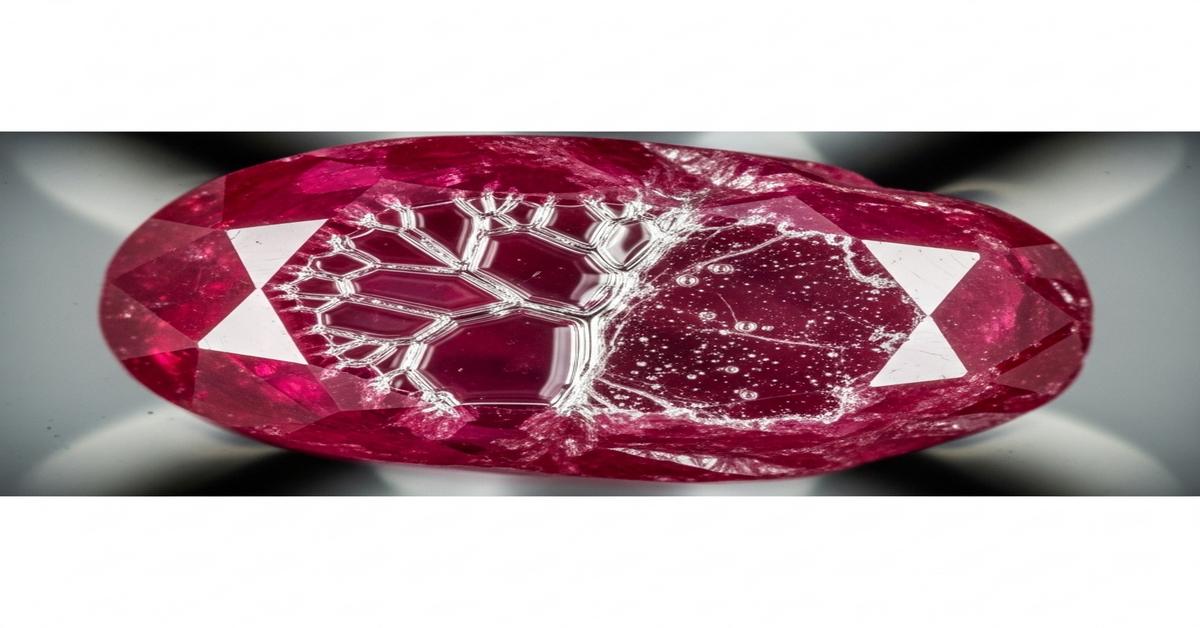
Glass-filled rubies look spectacular at first. The fractures are gone. The color deepens. For a modest price you can have a clear, bright red gem on a ring. That apparent perfection can be short-lived. Under a microscope the truth often shows: bubbles, flow lines, and a different optical behavior where the filling meets natural corundum. This article explains how glass-filling works, what you’ll see in microscope photos, why the effect breaks down in wear and repair, and how to care for or value these stones.
What glass-filling is and why it’s used
Glass filling is a post-cutting treatment where a low-melting, often lead-bearing glass is introduced into cracks and cavities in a ruby. Why do it? Fractures scatter light. Filling them restores light transmission and saturates color. That makes a low-grade crystal look like a commercial-quality gem. It is cheaper and easier than recutting or sourcing a higher-grade ruby.
How the treatment changes stone properties — and why that matters
Glass and corundum (ruby) have different physical and optical properties. Ruby (aluminum oxide) has a refractive index around 1.762–1.770 and a hardness of 9 on the Mohs scale. Typical lead-glass used for filling has a lower hardness and a refractive index that does not match corundum. That mismatch creates a visible boundary under magnification and makes filled areas mechanically weaker and chemically vulnerable. In practice that means the filled zones can chip, wear faster, react to cleaning chemicals, and even change appearance when heated.
What you’ll see under the microscope (typical magnifications and what they reveal)
- 10× magnification (standard loupe level): A trained eye may spot flash effects — sudden bright reflections inside fractures — and slightly rounded surfaces where the filling reaches the facet junction. These are hints rather than proof.
- 20–40× magnification: This is where most glass-fill evidence appears. Look for flow lines — curved, parallel layers inside the fracture indicating molten glass that flowed and solidified. You’ll also see small, often spherical gas bubbles trapped in the glass. Those bubbles are a strong indicator of glass, because natural healing fills from high-temperature flux typically lack large round bubbles.
- 40–100× magnification: You can measure bubble sizes and see meniscus shapes where the glass meets the crystal walls. Bubbles commonly range from roughly 10–200 µm (micrometers). You may also see bright, mirror-like surfaces inside a cavity — a sign the filling is glass rather than natural mineral growth.
Characteristic microscope photo features explained
- Flow lines: These look like layered bands inside a fracture. They form because molten glass flows and cools in layers. Their presence proves the filler was in liquid form when introduced — typical of glass-filling.
- Spherical bubbles: Gas trapped in molten glass forms round bubbles. Natural inclusions usually appear angular or irregular. Bubbles reveal an introduced molten phase.
- Sharp refractive boundary: At high magnification you’ll sometimes see a sharp line or meniscus between the glass and ruby. That line appears because the refractive index and surface tension differ. It can produce a “seam” that shows when tilted under light.
- Color concentration in-filled areas: The glass may carry colorants or allow light to pass in a way that saturates color along cracks. When the filling degrades, those areas can become dull or lose depth, revealing the original fractured look.
Why glass-filled rubies fail in use or repair
There are three practical reasons the “perfect” look doesn’t last.
- Mechanical weakness: Glass is softer and more brittle than corundum. Surface-reaching filled fractures can abrade and chip under normal wear. That produces dull spots or visible voids where the glass has been removed.
- Chemical and thermal sensitivity: Glass can be attacked by acids or alkaline cleaners and can soften, crack, or separate when heated. Jewelers soldering a ring or using steam cleaners can cause the glass to cloud or flow away from fracture walls. That changes the stone’s appearance and sometimes leaves visible cavities.
- Repair complications: Recutting or repolishing can remove filled material unpredictably. If a jeweler attempts to re-set or re-tension a stone with heat, the glass can melt or fracture differently than the host corundum, producing new damage.
How labs and sellers identify and report glass filling
Gem labs use microscope imaging, UV fluorescence, and sometimes chemical analysis. Lead or barium in the filling shows up on spectroscopy and X-ray fluorescence. Official reports will state “glass-filled” or “lead-glass filled.” Why this matters: disclosure affects price and care instructions. A one-carat untreated ruby might sell for thousands; a one-carat glass-filled may be a few hundred. The market expects full disclosure because the durability and value differ.
Practical advice for buyers and jewelers
- Ask for disclosure and photos: Request a close-up microscope image of any ruby described as “clarity-enhanced.” Sellers should state the treatment clearly.
- Care instructions: Avoid steam cleaners, ultrasonic baths, and any high-temperature exposure. Clean with a soft brush and mild soap. Remove rings with glass-filled rubies before heavy work that risks abrasion.
- Repairs: Tell your jeweler the stone is filled before any soldering or prong work. A common setting example: a 1.2 ct oval ruby (approx. 7.0 × 5.0 mm) set in 14k yellow gold (58.5% Au) should not be exposed to direct torch heat during repairs if filled.
- Resale and insurance: Expect lower appraisals. Insurers and buyers price in treatment and service life. Consider replacing a glass-filled center stone with a better-quality or synthetic gem for long-term durability in daily-wear pieces.
Final note — what microscope photos teach us
Microscope photos are not just proof of treatment. They explain the how and why: how molten glass altered the stone’s optics, and why that change can reverse or fail under common stresses. If a ruby looks “too perfect” for its price, a close look at 20–40× will usually tell the story. That visual evidence should guide buying, setting, and caring decisions so the stone remains attractive and safe to wear.